Manufactured under BIS licence
Built to IS : 1180 under CML No. 7200106894, which permits the ISI mark on the rating plate.
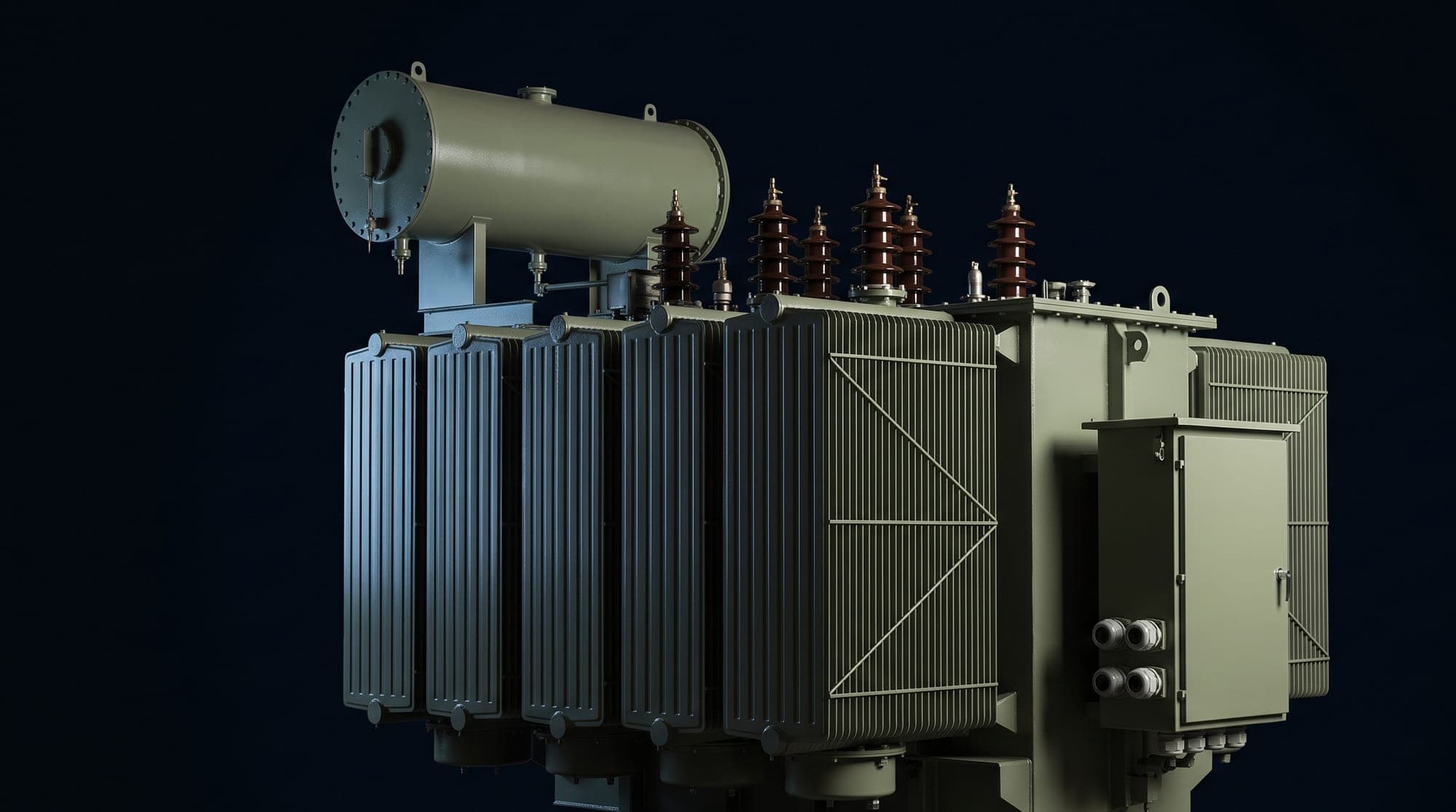
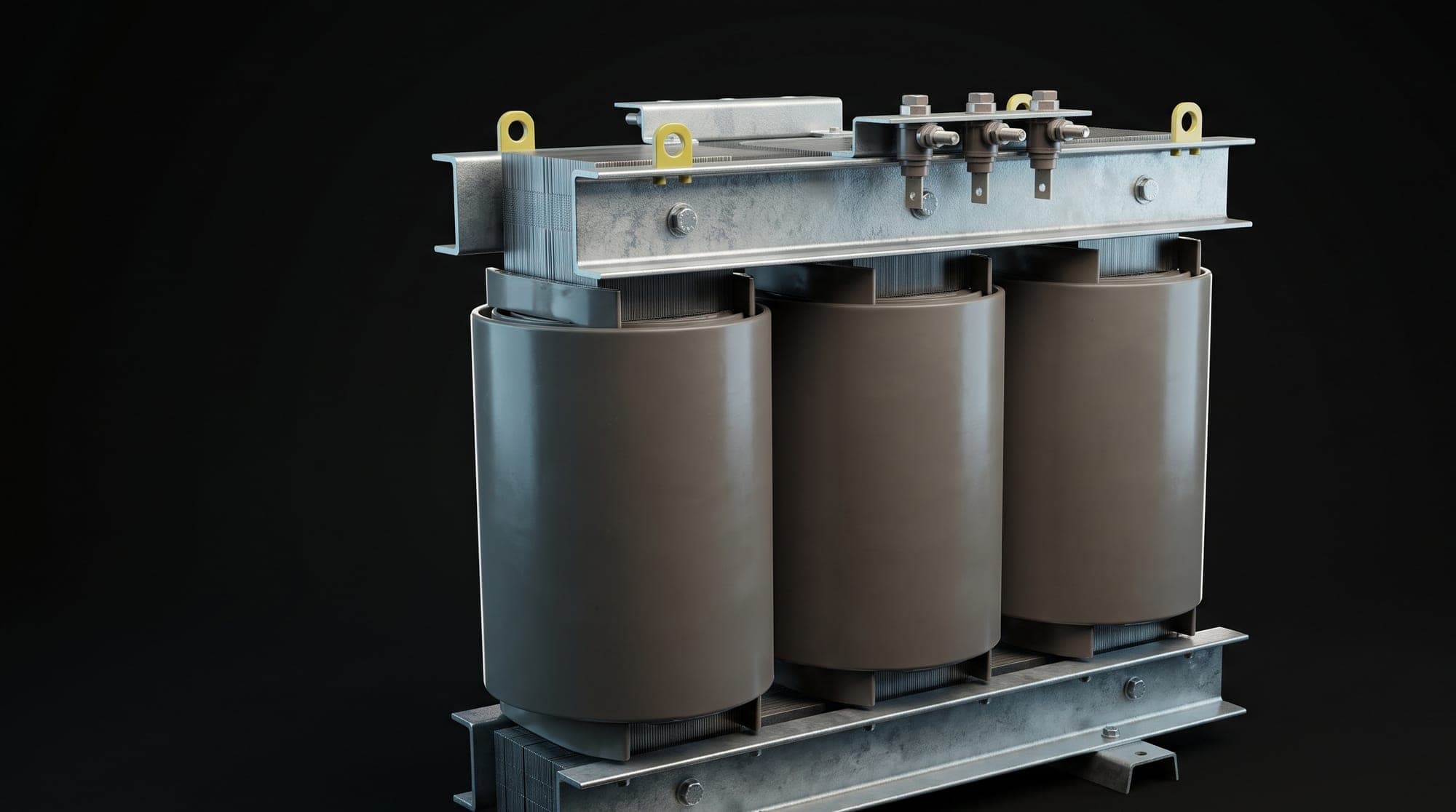
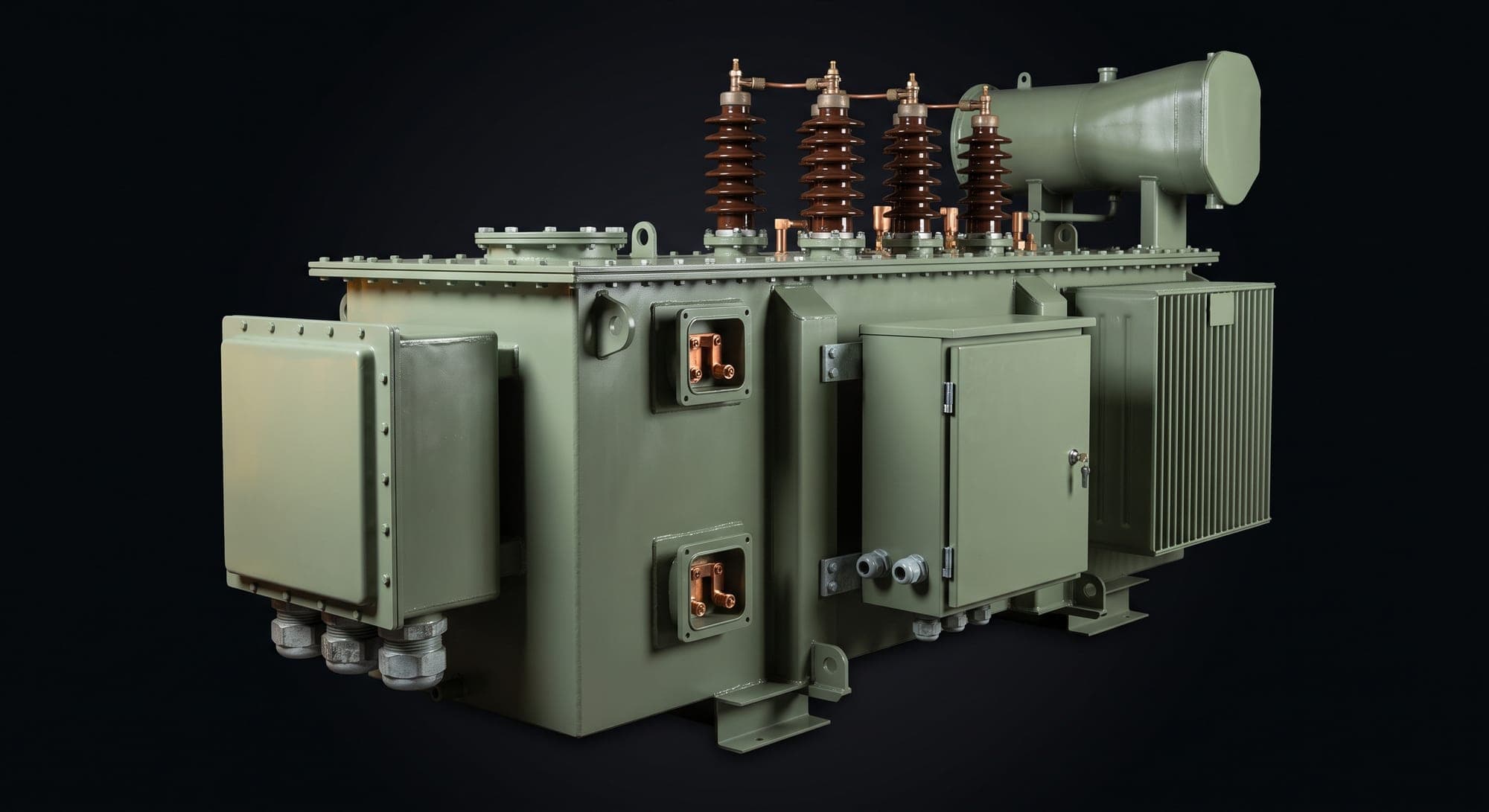
Illustration — representative of the product type
11 – 66 kV · IS : 1180
Oil-immersed distribution transformers manufactured under our BIS licence to IS : 1180, with conservator, pressure relief and off-circuit tap changer. Core, windings and tank are produced and assembled at our GIDC Sachin works, then routine-tested before dispatch.
Overview
A distribution transformer is the last step down before the load. It sits on a feeder pole or a plinth, runs continuously for decades, and is judged almost entirely on two things: how little it loses at light load, and how long it survives without attention. Both are decided at the design and winding stage, not at commissioning.
We manufacture these under our own BIS licence to IS : 1180, which means the core stacking, coil winding, tanking and routine testing all happen at our works in GIDC Sachin. A licence is granted against an audited process and a tested product — it is not a badge that can be bought in, which is why we do not sub-contract the steps it covers.
Every unit leaves with its full routine test certificate set. If it needs attention later, the same works that built it can rewind it, filter its oil or attend site.
Built to order. Send your required rating and voltage class and we will confirm against your specification.
Key features
Built to IS : 1180 under CML No. 7200106894, which permits the ISI mark on the rating plate.
Core cutting, stacking and winding happen on our own floor, so the parts that decide losses are the parts we control.
Ratio, resistance, insulation and no-load tests are carried out at our works, with the certificate set supplied on delivery.
Standard oil-preservation fittings, with breather and pressure relief device sized for the tank.
Rewinding, onsite maintenance and oil filtration are handled by our own teams, not passed to a third party.
Off-load tap selection for supply-voltage variation, with the tapping range set to your specification.
Applications
The sectors this unit is specified for most often, and what each of them is actually solving for.
A distribution utility owns thousands of transformers spread across a network, most of them lightly loaded for most of their lives and none of them convenient to reach.
View sector →Solar plants need step-up and auxiliary transformers that spend their lives cycling — full output at midday, nothing at night — which is a different ageing problem from continuous industrial duty.
View sector →Surat runs on textile processing, and the loads are unforgiving: continuous three-shift operation, heavy motor starting, airborne lint and dust that block cooling surfaces, and ambient temperatures inside a mill that sit well above the design assumption..
View sector →Most of the world’s diamonds are cut and polished in Surat, and the units that do it sit on tight city plots in Varachha, Katargam and Mahidharpura — multi-storey buildings with hundreds of polishing spindles and laser sawing machines running through the day, and no yard to put a transformer in.
View sector →Related
Service
Failed units returned to service, not replaced
Read more →Service
Restore dielectric strength without a shutdown replacement
Read more →Knowledge
The dividing line is duty, not size. How load profile, loss economics and impedance decide which type a job actually needs.
Read article →Questions
It certifies that the unit was manufactured under a live BIS licence to IS : 1180 — in our case CML No. 7200106894. BIS grants the licence against an audited manufacturing process and independently tested product, and can withdraw it. It is a statement about how the transformer was made, not just a claim about the finished item.
ONAN is Oil Natural, Air Natural — the oil circulates by thermosiphon and the radiators lose heat to still air, with no moving parts. ONAF adds forced air from fans, which raises the continuous rating of the same tank. Distribution units are almost always ONAN because the rating does not justify fans and there is nothing to fail.
Winding life is governed by insulation ageing, which is driven by temperature and by moisture in the oil rather than by years in service. A unit kept dry, correctly loaded and with its oil filtered when the BDV drops will run for decades. One that is chronically overloaded or has wet oil can lose its windings far sooner. This is why oil condition is worth monitoring.
Usually, yes. Send us the rating plate photograph — it carries the rating, voltage ratio, vector group, tapping range and impedance. Matching impedance and vector group matters most where units run in parallel, because a mismatch causes circulating current between them.
Related products
Enquiries
Send us the rating, voltage class, vector group and quantity. For a like-for-like replacement, a photograph of the existing rating plate is usually enough.