Transformer oil is doing two jobs at once, and most maintenance schedules only
account for one of them. It carries heat away from the core and windings, which
is the obvious job. It is also part of the insulation system — the dielectric
that stops the high-voltage winding from finding a path to the tank.
The first job degrades gracefully. The second one does not.
Three things accumulate in service, and they matter in roughly this order.
Moisture is the most damaging and the least visible. Water enters through
a failed breather, a leaking gasket, or simply from the atmosphere during a
maintenance opening. It also comes from within, as the cellulose insulation on
the windings ages and gives up water as a by-product. Dissolved water lowers
dielectric strength sharply — a few tens of parts per million is enough to
matter.
Particulates come from manufacturing residue, from the slow shedding of
cellulose fibres, and from any metallic debris a tap changer or a pump
generates. Suspended particles give a partial discharge somewhere to start.
Oxidation products are different in kind. As oil ages thermally it
oxidises, acidity rises, and sludge eventually forms and deposits on winding
surfaces where it blocks the cooling ducts it was supposed to flow through.
Filtration addresses the first two. It does not reverse the third, and that
distinction is the whole basis of deciding what to do.
You cannot tell by looking. A transformer with badly degraded oil looks
exactly like a healthy one from outside, right up until it does not.
The headline measurement is breakdown voltage, usually called BDV — the
voltage at which a sample arcs across a standard gap. It responds strongly to
both moisture and particulates, which is precisely why it is the standard
screening test. A falling BDV means something is accumulating.
Two more tests are worth having when the BDV result is ambiguous:
- Moisture content, measured directly in ppm, which separates a wet-oil
problem from a dirty-oil problem
- Acidity, which detects the oxidation that filtration cannot fix
The single most useful thing you can do is not a test at all — it is keeping
the results. One BDV reading tells you very little. Four annual readings tell
you the direction and the rate, and the rate is what should set your interval.
Filtration is appropriate when the oil has taken on moisture and particulates
but has not chemically degraded. In practice that covers most cases,
particularly on units that are middle-aged rather than genuinely old.
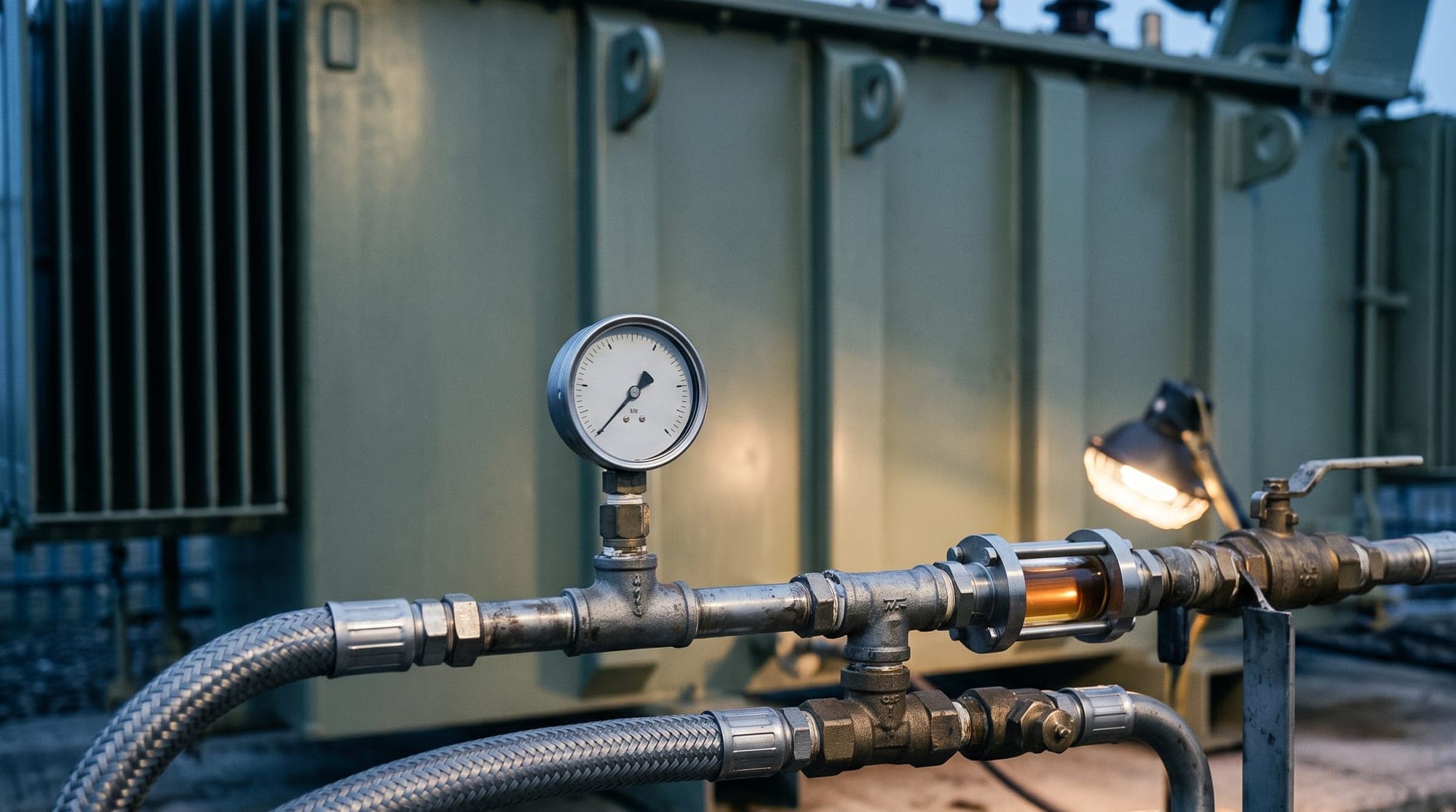
The process is straightforward. Oil is circulated through a filtration plant
that removes particulates mechanically and draws off dissolved moisture under
vacuum. It happens onsite, with the transformer in place — which matters,
because the alternative involves moving something that may weigh several
tonnes.
Filtration is not the answer when acidity has risen and sludge has begun to
form. At that point the oil itself has changed chemically, and no amount of
circulation will restore it. Replacement is correct, and the sludge already
deposited on the windings needs addressing too.
It is also not the answer when the oil is darkened and smells burnt. That
indicates a thermal fault inside the tank, and filtering it treats a symptom
while the cause continues. Investigate first.
The economic argument is unusually clear, because insulation ageing is driven
by temperature and moisture together. Wet oil accelerates the ageing of the
cellulose insulation on the windings — the one component of a transformer that
genuinely wears out and cannot be restored. Everything else can be repaired.
So filtration is not really about the oil. It is about slowing the clock on the
windings, which are the expensive part. Measured against the cost of a rewind,
periodic filtration is not a close comparison.
There is no universal interval, because loading, ambient conditions, breather
maintenance and tank sealing all vary. What works is this:
- Sample annually and record the BDV.
- After two or three years you have a trend rather than a number.
- Act on the trend, not on a single reading crossing a threshold.
- When you do filter, test before and after and keep both figures.
A unit whose BDV is stable year on year needs nothing. One that is falling
steadily needs attention well before it reaches the point where the reading
alarms you.
And whenever moisture turns up, find the ingress path. Filtering wet oil
without fixing the failed breather or the perished gasket that let the water in
means doing it again next year.
Related: Transformer oil filtration service ·
Onsite maintenance ·
Transformer maintenance checklist